Smarter Batteries, Smarter Grids: How Intelligent Battery Scheduling Is Transforming Modern Power Networks
By Ejikeme A. Amako • May, 2026 • 8 min read
"The future electric grid won't simply generate cleaner energy—it will have to think smarter about when, where, and how that energy is used."
Picture this: it’s a hot summer afternoon, and thousands of solar panels across your neighborhood are producing more electricity than anyone can use. Fast forward a few hours—sudden cloud movement causes highly variable solar PV outputs, but air conditioners are still blasting, and electric vehicles are plugging in as people get home from work. Suddenly, the previously high solar power output becomes unpredictable while electricity demand shoots through the roof.
This daily drama plays out across power grids everywhere. And here’s the thing: we’ve gotten pretty good at producing renewable energy. The real puzzle? Managing it intelligently.
Battery Energy Storage Systems (BESS) have emerged as one of our best tools for balancing renewable generation with actual electricity demand. But here’s what surprised me during my research—having batteries isn’t enough. BESS can do much more: energy shifting, black-start capability, frequency leveling, and power quality improvement. Without smart scheduling, even massive storage systems can end up charging or discharging at the wrong moments, missing opportunities to reduce peak demand, stabilize the grid, and minimize large power deviations that cause voltage instability and power quality issues in distribution networks. These challenges are especially pronounced in Active Distribution Networks (ADNs), where multiple communities and distributed energy resources interact in complex ways.
This realization sparked my recent research on intelligent battery scheduling for ADNs. The work evolved across two publications—starting with coordinating batteries between two neighboring communities and scaling up to a framework that can manage multiple utility-scale communities within large distribution networks.
The key insight? Instead of treating each battery as a lone wolf doing its own thing, what if we got them working together as a team? High solar irradiance fluctuations that result in rapid changes in power output can strain the grid—but coordinated BESS scheduling can mitigate these effects. The result is a grid that reduces peak demand, keeps voltages stable, minimizes energy losses, and does all this fast enough to be practical for utility operations.
The Renewable Energy Challenge Isn't Solar—It's Timing
Renewable energy has fundamentally flipped how distribution systems work. Traditional power grids were built around a simple idea: big centralized power plants would crank up generation whenever people needed more electricity. Clean. Simple. Predictable.
Today’s grids? Not so much. Now we have thousands of community and rooftop solar systems injecting power throughout the day, creating bidirectional power flows and voltage swings that conventional distribution systems were never designed to handle.
When solar production suddenly spikes, voltages can climb beyond safe limits. Then a cloud rolls by, and PV output can crash within seconds, forcing the grid to scramble. Later that evening, as solar generation disappears but demand stays high, utilities face what we affectionately call the duck curve—a steep ramp in net demand that can stress the entire system.
Batteries help smooth out these wild swings by storing surplus solar energy during the day and releasing it when demand peaks. But figuring out when each battery should charge, how much energy to store, andwhen to discharge during cloud-cover events becomes incredibly complex as more communities and distributed resources join the grid.
From Two Communities to Utility-Scale Networks
In my first study, presented at an IEEE Power and Energy Conference (TPEC), I tackled a straightforward but important question:
Can neighboring communities coordinate their battery systems to mitigate voltage instability instead of each operating independently?
To find out, I developed a two-stage scheduling framework for an IEEE Test Feeder ADN with two neighboring communities, each equipped with co-located PV-BESS systems. The approach combined a fast rule-based decision process with Particle Swarm Optimization (PSO) to optimize battery operations while respecting network limits.
To speed things up, I leveraged parallel processing using a distribution system power solver, allowing multiple community scheduling problems to be solved simultaneously rather than sequentially.
The results were encouraging—coordinated scheduling reduced peak demand, improved voltage stability, lowered system losses, and cut simulation time by more than 96% through parallel processing.
But those results naturally raised another question:
Would this approach still work for real utility-scale distribution systems with thousands of buses and multiple independent communities?
That question became the foundation for the next publication. Building on the original framework, I expanded the methodology to coordinate four communities within the massive IEEE 8500-node ADN—a true utility-scale network. This version also incorporated IEEE 1547‑2018 smart inverter functions, including Volt–VAr, Volt–Watt, and combined Volt–VAr/Volt–Watt control, to provide additional voltage support alongside intelligent battery scheduling.
Together, these two studies tell a story of progression: the first showed that coordinated battery scheduling works, while the second proved it can scale to handle the complexity of modern utility distribution systems.
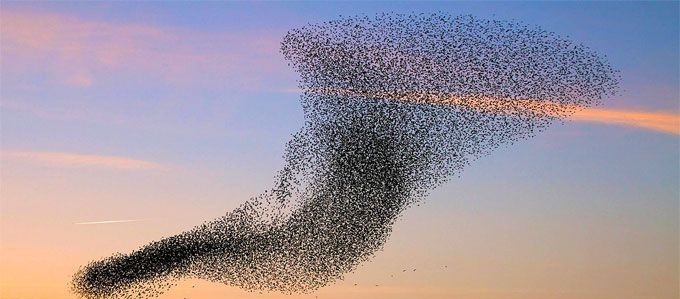
Figure: Bio-inspired foundation of the implementation of PSO algorithm.
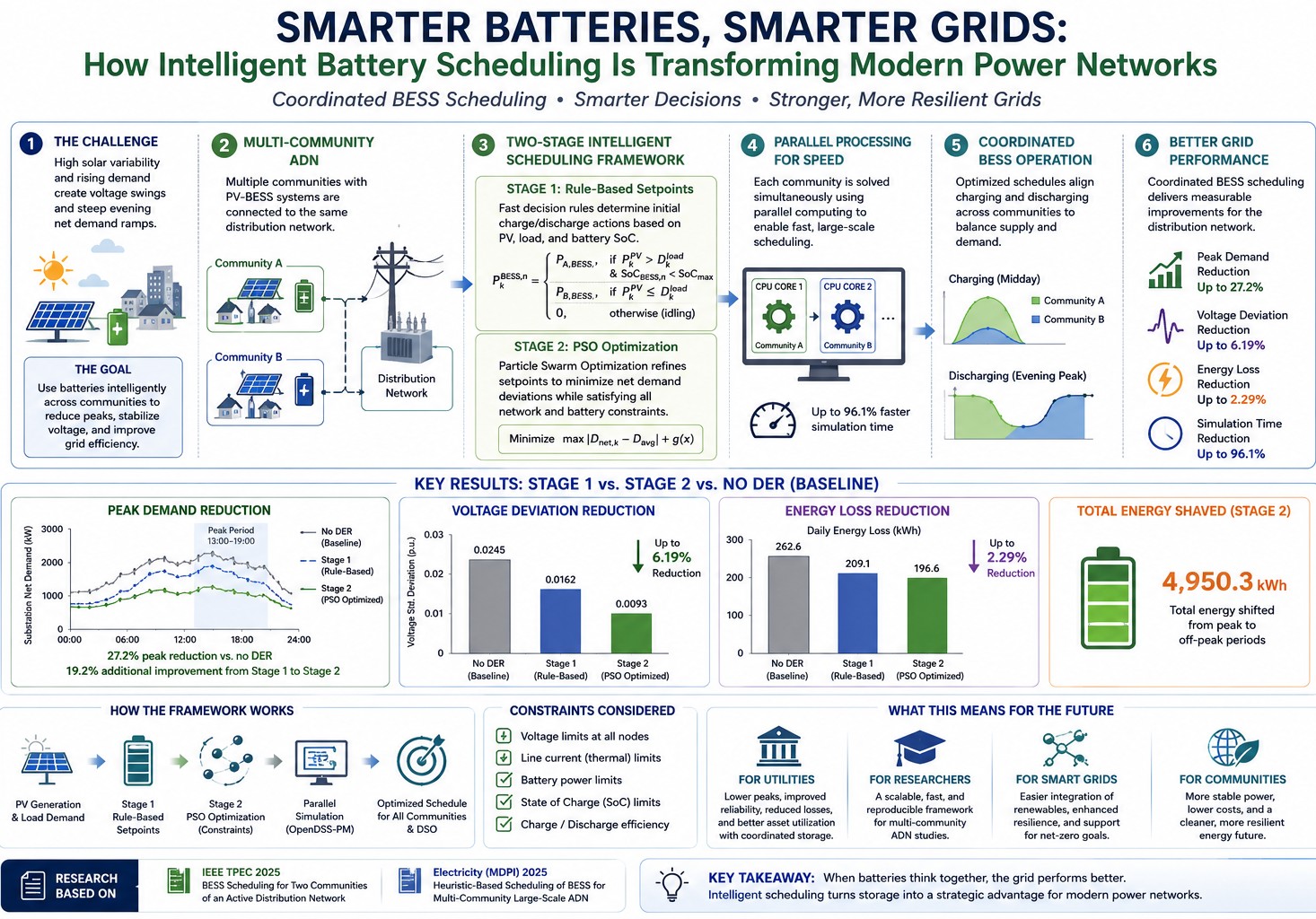
Figure: How Intelligent Battery Scheduling is Transforming Modern Power Networks.
A Two-Stage Intelligent Scheduling Strategy
At the heart of the framework is a simple philosophy: optimization should be both fast and intelligent.
The first stage quickly determines whether each battery should charge, discharge, or remain idle using forecasts of community demand, available PV generation, and battery state of charge. This rule-based approach provides a solid starting point without burning computational resources on expensive optimization.
Stage 1 — Rule-Based BESS Scheduling: Here it compares each community's PV generation, load demand, and battery state of charge to determine whether the BESS should charge, discharge, or remain idle.
The second stage takes those initial decisions and refines them using Particle Swarm Optimization (PSO). If you're not familiar with PSO, think of how birds flock together—each bird adjusts its flight based on its own experience and what the rest of the flock is doing. PSO works similarly, searching for battery schedules that minimize fluctuations in community net demand while satisfying voltage limits, battery constraints, power balance requirements, and network current limits.
Rather than optimizing each battery independently, the framework coordinates them so neighboring communities work together to reduce stress on the distribution network.
Stage 2 — Community Scheduling Optimizer Model determines charging and discharging schedules for each community’s BESS. The optimizer minimizes the maximum deviation between the net demand and its daily average at each community’s PCC.
Subject to:
Why This Matters
As electric grids continue evolving, batteries are becoming far more than just sources for services such as arbitrage, peak shaving, energy resilience, and ancillary support—they’re turning into intelligent grid assets.
For electric utilities, coordinated battery scheduling offers a practical path to reduce peak demand, improve voltage regulation under high PV variability, integrate more renewable energy, and defer costly infrastructure upgrades.
For researchers, the framework shows how optimization algorithms, parallel computing, and standardized smart inverter controls can be woven together into scalable decision-support tools for increasingly complex distribution systems.
For the future smart grid, the message is even bigger: successful renewable integration isn’t just about installing more solar panels or larger batteries—it’s about coordinating those resources intelligently. Smarter batteries, smarter inverters, and smarter algorithms will enable cleaner, more resilient, and more efficient power systems that can actually meet tomorrow's energy challenges.
As distributed energy resources continue to proliferate, intelligent coordination will become just as critical as the technologies themselves. Because here's the truth: smarter batteries don't just store energy—they help create smarter grids.
For more details, you can check out the publications below, which provide a deeper dive into the methodologies and results of this research.
Publications
BESS Scheduling for Two Communities of an Active Distribution Network
E. A. Amako, A. Arzani and S. M. Mahajan, "BESS Scheduling for Two Communities of an Active Distribution Network,"2025 IEEE Texas Power and Energy Conference (TPEC), College Station, TX, USA, 2025, pp. 1-6,https://doi.org/10.1109/TPEC63981.2025.10907021
IEEE Texas Power and Energy Conference (TPEC), 2025
Heuristic-Based Scheduling of BESS for Multi-Community Large-Scale Active Distribution Network
Amako, E. A., Arzani, A., & Mahajan, S. M. (2025). Heuristic-Based Scheduling of BESS for Multi-Community Large-Scale Active Distribution Network. Electricity, 6(3), 36.https://doi.org/10.3390/electricity6030036
Electricity (MDPI), 2025